
Digital Da Vinci
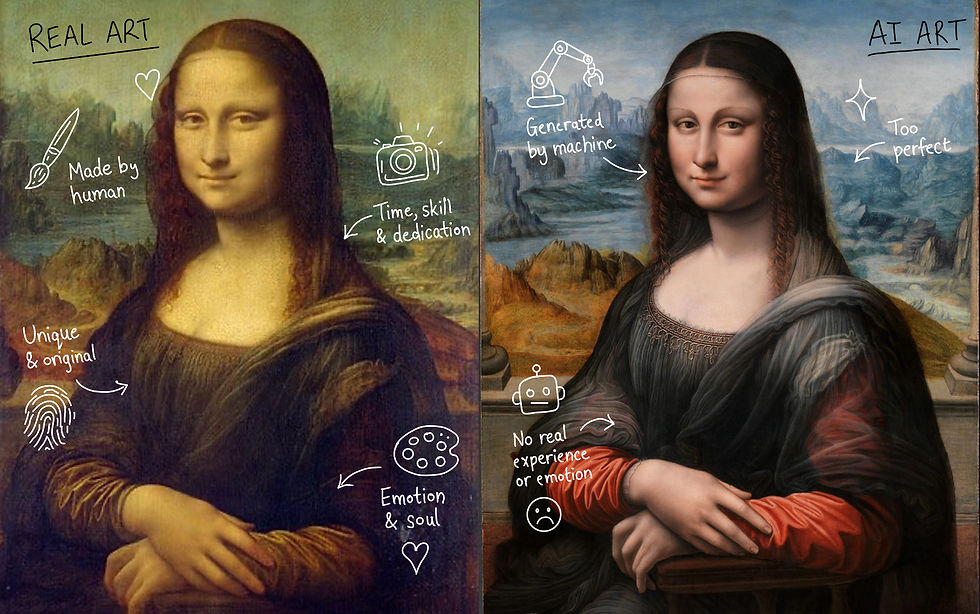
AI makes art fast, but it can’t spill paint on your favorite jeans.
By Kavya Lajpal
Imagine describing an image in your head and seeing it appear in seconds. No
brushes, no camera, no hours of work just a few words and the picture is there. It
almost feels like creative superpowers. That’s why AI art is suddenly everywhere from
Instagram posts and college projects to brand campaigns. But while it’s exciting, it
also raises a question: is this the future of creativity, or something that might change
what being an artist really means?
For many people, it feels exciting at first.
Ananya Verma, 20, a fine arts student at MIT Institute of Design, Pune, says,
“Trying Midjourney out of curiosity revealed how AI-generated art works. Midjourney is an AI
tool that creates images from text prompts and it isn’t completely free, subscriptions
usually start at about ₹800–₹900 per month, with higher plans going up to around
₹2,500, ₹5,000, or even close to ₹10,000 depending on usage. A simple prompt such
as ‘a girl sitting by a window in soft sunset light, painted in an oil painting style’
produced an image within seconds that looked like a gallery artwork. It was
impressive, but also uncomfortable. Years are spent learning how to draw faces,
understand lighting, and mix colours, and yet the AI produced something visually
similar in seconds.”
Her reaction is common. Many artists worry that AI tools learn by looking at
thousands of artworks made by real people, sometimes without asking for
permission. It studies these images and then creates something new that may look
similar. This raises an important question, who should get the credit? Is it the person
who typed the prompt? The company that created the AI? Or the artists whose work
the AI learned from?
"AI may imitate style, but it cannot imitate struggle, memory, or emotion." Arjun Khanna, 21, a communication design student at Istituto Marangoni
At the same time, not everyone sees AI tools like DALL·E, or Adobe Firefly as a danger.
Some students and designers think of them as just another tool, like Photoshop or a
camera, something that can help but not replace human ideas. However, these
platforms work on different pricing models. DALL·E can be accessed through
platforms like ChatGPT and usually offers limited free image generations before
requiring paid credits. Adobe Firefly also provides a few free generative credits, but
full access is typically included in Adobe Creative Cloud plans starting at around
₹1,600–₹1,700 per month in India. Even though they differ in cost, many designers
still see these AI platforms as supportive tools rather than replacements for human
creativity.
Arjun Khanna, 21, a communication design student at Istituto Marangoni, Mumbai, says, he
uses ChatGPT when he feels stuck. “Sometimes I just open the free version of ChatGPT and
type a rough idea. For example, I might ask for poster concepts for a music festival, colour
palette ideas for a streetwear brand, or visual themes for a fashion campaign. Seeing a few
creative suggestions pushes my thinking in new directions. I don’t copy what it gives me, but
it helps me break creative blocks.” For Arjun, AI is not the final artist, it’s more like a
brainstorming partner.
However, others worry about the long-term impact on jobs, and originality. Simran Kaur, 23, a
freelance illustrator based in Mumbai, collaborated on digital campaigns with Nykaa, says
“Some brands would rather generate quick visuals instead of paying an illustrator, it makes
you question your value. Art is not just about the final image. It’s about the thought,
emotion, and experience behind it. AI doesn’t have that.” She has already seen clients
choosing AI over human artists for smaller projects.
For many artists like Simran, the concern is not just about technology, but about recognition.
AI tools can generate images quickly, but they rely on data drawn from human creativity.
To understand why many artists feel protective about their work, it helps to look at how
human art has historically been valued.
History shows how deeply personal and valuable human art can be. Paintings by legendary
Indian artists like M. F. Husain, Satish Gujral, and S. H. Raza have sold for astonishing amounts at international auctions. Husain’s monumental 1954 painting “Untitled (Gram Yatra)” sold for around ₹118 crore at a Christie’s auction in New York, becoming the most expensive modern Indian artwork ever sold”
.
Similarly, works from Raza’s iconic 1980 painting “Bindu” series, which explore spirituality
and the concept of cosmic energy through a single central dot, have sold for over ₹4 crore at
auctions, reflecting their global demand among collectors. Meanwhile, Satish Gujral’s 1954
painting “The Despair”, reflecting the trauma of Partition and Indian history, was sold at
Christie’s New York on September 14, 2016, for $ 125,000 (over ₹1 crore).
These artworks are valued not just for their visual beauty but for the stories, cultural
context, and personal journeys behind them. Unlike AI-generated images, every brushstroke
in these works reflects the artist’s experiences, struggles, and philosophy, which is what
makes collectors willing to pay such extraordinary prices.
AI images, on the other hand, are generated in seconds and can be reproduced endlessly.
They may look impressive, but they do not carry the same history, struggle, or human
narrative that collectors and galleries often value.
There are also broader drawbacks. AI art raises questions about copyright, ownership, and
authenticity. It can sometimes copy styles too closely, blur the line between original and
generated work, and make it harder for emerging artists to stand out in a digital space
already flooded with images.There are also broader drawbacks. AI art raises questions about
copyright, ownership, and authenticity. It can sometimes copy styles too closely, blur the line between original and generated work, and make it harder for emerging artists to stand out in a digital space already flooded with images.
As AI tools become more common, the real challenge will be finding a balance, where technology supports creativity without overshadowing the people behind it. Because while machines can generate images, the meaning behind art still comes from human experience.


Comments